Showing posts with label history. Show all posts

Sunday, January 20, 2013

Geechee Profile: Philip Simmons

Photo Credit: http://southcarolina1670.wordpress.com/

Philip Simmons was born June 9, 1912 on Daniel's Island, South Carolina. Mr. Simmons lived on the island with his grandparents until he was 8 years old. He was then sent to live with his mother in the city of Charleston. At the age of 13, Mr. Simmons began to apprentice under a blacksmith by the name of Peter Simmons (no relation), a former slave. After a 5 year apprenticeship, at the age of 18 Mr. Simmons became a full blacksmith. 


Mr. Simmons began his 77 year career making simple things such as horseshoes. His first commissioned work was for Jack Krawcheck, during WWII, where he had to use scrap iron to make a gate because wartime materials requirements made it impossible to get iron. 
 
Mr. Simmons created all types of ironwork including fences, gates, balconies, fireplace pokers, and various tools. Much of his work can be seen in and around the city of Charleston. 


Philip Simmons has been awarded the National Heritage Fellowship from the National Endowment of the Arts, a Lifetime Achievement Award by the South Carolina General Assembly, the Order of the Palmetto, and the Elizabeth O'Neill Verner Governor's Award.  Mr. Simmons has been inducted into the South Carolina Hall of Fame. Mr. Simmons’ work has been on display at the Smithsonian.

 Mr. Simmons, after retiring from blacksmithing, continued to teach his craft until he was no longer able. Philip Simmons died June 22, 2009, at the age of 97. He is truly a Charleston icon.


 I had the pleasure of meeting, and speaking with Mr. Simmons on several occasions, and he was one of the sweetest people I've ever met. 

To learn more about Mr. Simmons visit: Philip Simmons Foundation, Inc
Biography:  Charleston Blacksmith, The Work of Philips Simmons by John Michael Vlach
Documentary: Keeper of The Gate by David Flander
Interview:http://www.aaa.si.edu/collections/interviews/oral-history-interview-philip-simmons-11873


If you are ever in Chaleston here is list of places that you can see Mr. Simmons' work:
  • The gazebo at the Charleston International Airport
  • Gates outside the Charleston Vistors Center
  • The egret gates at Waterfront Park
  • The Gadsden house gate at 329 East Bay St.
  • The gate at 2 st. Michael’s Alley
  • The railings and window grilles at 45 Meeting St.
  • The heart gates at St. John’s Reformed Episcopal Church at 91 Anson St.
Picture Source: http://fycharleston.tumblr.com/post/40688453488/philip-simmons-a-charleston-legend-1912-2009


Sunday, December 9, 2012

Blue Bottle Tree

      
The blue bottle tree is another one of those southern tradition that many people don't know the complete history of.  Having a blue bottle tree in the yard is a old Gullah/Geechee custom. The trees are used to capture evil haints for getting into one's home. The haints are lured inside the bottle by light reflected thru the blue bottle at dusk. Once the haints are inside the bottle they are trapped. What happens to them are up for debate. Some say that they are trapped in the bottles forever, and the noise you hear are the haints moaning, and crying. Others say that once the sun rises the haints are vaporized by the sun's light. 


Today, people use different color bottles, but blue was the choosen by the Gullah/Geechee people for a reason. The Gullah/Geechees used blue because of their belief that the color blue wards off evil spirits. 

Do you know anyone with a blue bottle tree in their yard?


Sunday, October 21, 2012

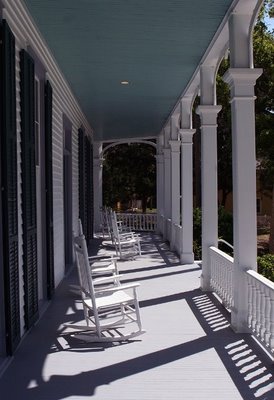
Haint Blue: The REAL reason porches have blue ceilings.

The REAL reason  porches have blue ceilings.
 
 
In Gullah/Geechee tradition the color blue is used to keep evil
spirits away. The Gullah/Geechee call those evil spirits, Haints. The
practice was brought over from Africa during the slavery. The legend
of the Haint is they can't cross water, so because slaves couldn't
build motes around their houses, they would use a watery mixture of
blue around the openings of their homes. They hoped that the blue
mixture would confuse the Haints into thinking the paint was water.
During slavery, Haint Blue was made in pits, dug in the yard, using
limes, buttermilk, and indigo. The practice of using blue paint on houses still
goes on today, especially in the South. If you've traveled to places such as Charleston, SC or
Savannah, Ga you may have noticed that porch ceilings, shutters, and
the trim on houses are often blue. 
Picture Source: http://www.kitchenandresidentialdesign.com


Tuesday, October 9, 2012

Who are the Geechee People?

The Gullah/Geechee people are the descendants of slaves, brought over
from West and Central Africa, that live in the coastal regions of
South Carolina, Georgia, portions of Florida, and North Carolina-known
to some as the Gullah corridor.  In Georgia there are sub- groups of
the Gullah/Geechee people, the Saltwater Geechees, and the Freshwater
Geechees. The Gullah/Geechee is one of the oldest surviving cultures
in the US. 
 
The Gullah/Geechee Corridor 
 
Picture Source: National Park Service 
 
 
 A brief history:

   During the eighteenth century, plantation owners in South Carolina
and Georgia wanted slaves who could grow rice in the humid subtropical
climate of the Sea Islands.  Due to the difficulty of growing
rice, and the fact that the slaves had some resistance to diseases, such
as malaria and yellow fever, the owners of the plantations paid higher
prices for slaves from Western Africa. West Africa is sometimes
referred to as the rice coast. The slave owners, who were susceptible
to yellow fever and malaria, mostly lived inland for most of the year,
while leaving the slaves on the Sea Islands, such as St. Simons
Island, St. Helena Island, Hilton Head Island, and Sapelo Island. When
the slaves were freed after the Civil War, many Gullah bought the land
on which they worked on and continued their agrarian way of life. This
would be their life for the next one hundred years. As time moved on,
the Gullah/Geechee people moved to the mainland, for example
Charleston, SC, and Savannah, Georgia, then on to other areas.
 
 
  The Sea Islands of South Carolina, and Georgia.
Picture source: Wikipedia


 The Language:

  The Africans, captured from Sierra Leone, Angola, Liberia, and other
countries, were held together as they began to develop a pidgin
language. The language or dialect that the Gullah/Geechee people speak
is also referred to as Gullah, and/or Geechee. This language is the
blending of the pidgin language with English, spoken by the slave
masters, and over 4000 different African words, from many different
tribes. The Gullah language is heavily influenced by Sierra Leone
Krio.

There are several theories about where the word Gullah actually comes
from.  Some believe that the word Gullah came from Angola. Others
believe the word came from the tribe of Gola, which is near the border
of Liberia and Sierra Leone, where the Mende, and Vai territories come
together. Yet others believe that the word, "Gullah" could also draw
from Gallinas, which is another name for the Vai, or posibbly from
Galo, which is the Mende word for the Vai people.